AI Workforce Professional
Deploy production systems with evaluation suites, security, and unit economics.
Separate a demo hobbyist from a production AI engineer. Master enterprise system boundaries, evaluation pipelines, token unit economics, OpenTelemetry observability, zero-trust RBAC, and client delivery pricing.
Level 1 is a prerequisite for advanced tiers. Complete Foundation to receive early priority access to this cohort.
Explore Level 1: FoundationsSenior software engineers, AI consultants, and tech leads deploying mission-critical AI systems to clients or enterprise employers.
- Completion of Level 2: Builder or verified production agent deployment experience
- Deep understanding of backend service boundaries, queues, and database schemas
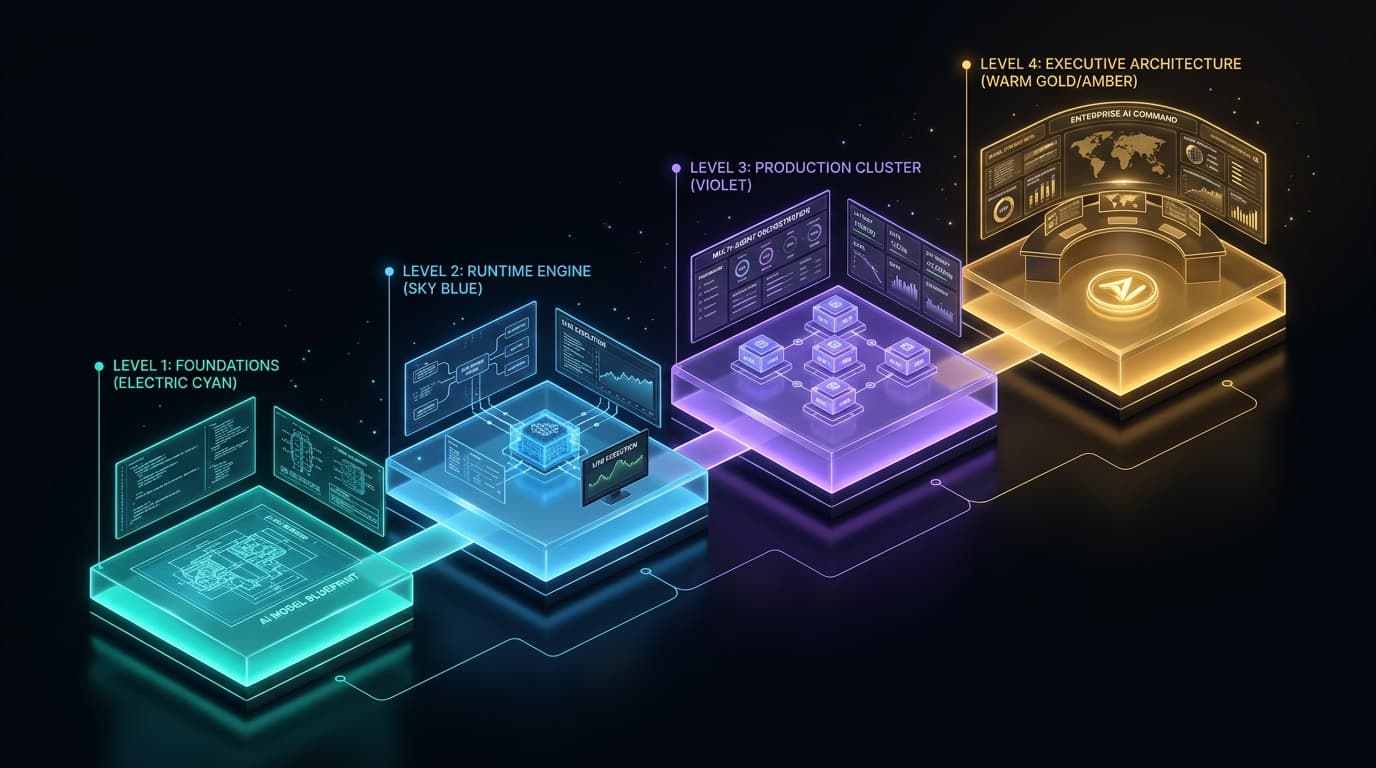
What You Will Engineer
Architect asynchronous event-driven AI runtimes with queues and background jobs
Implement zero-trust tool security, RBAC policies, and prompt injection firewalls
Build automated evaluation suites with golden datasets and LLM-as-judge benchmarks
Instrument OpenTelemetry logging, tracing, token counters, and latency alerts
Model exact cost-per-task unit economics and automation ROI metrics
Deliver enterprise integrations across CRM, ERP, Slack, Teams, and OAuth
Syllabus Architecture
Module 1: Production Architecture
Service boundaries, queues, background jobs, event-driven design, scaling, caching, and database architecture.
Module 2: Security & Permissions
RBAC, tool sandboxes, secret isolation, prompt injection firewalls, sensitive data redaction, and audit logs.
Module 3: Evaluation Engineering
Golden datasets, LLM-as-judge, human evaluation, tool correctness, retrieval quality, and regression pipelines.
Module 4: Observability & Operations
OpenTelemetry logging, tracing, token usage, latency alerts, tool failure monitoring, and incident handling.
Module 5: AI Economics
Cost per task, token economics, API costs, human review overhead, automation ROI, and service pricing models.
Module 6: Enterprise Integrations
Enterprise CRM, ERP, Slack, Teams, databases, OAuth, enterprise permissions, and bi-directional webhooks.
Module 7: AI Workforce Design
Department design, employee boundaries, shared knowledge, shared infrastructure, and cross-employee communication.
Module 8: Client Discovery & AI Audits
Interviewing stakeholders, process mapping, opportunity audits, risk assessments, ROI estimation, and proposals.
Module 9: Pricing & Delivery
Project pricing, retainers, managed AI employees, SLAs, maintenance, usage pricing, and change management.
Module 10: Portfolio Case Study
Problem, before state, architecture, implementation, tools, evaluation, security, cost, results, and lessons learned.
Practical Project Defense & Rubric Review
Production AI Employee Case Study: Comprehensive production case study documenting Problem, Before State, Architecture, Implementation, Tools, Evaluation Suites, Security, Cost per Task, and Results to present to clients or employers.
Begin your journey in AI Workforce Professional.
Master the architectural patterns that transform language models into reliable, production AI workers.