AI Workforce Builder
Build working AI employees with tools, state engines, and human escalation.
Stop talking primarily about concepts. Write real code to build functioning AI employees with production LLM patterns, vector knowledge layers, function calling, stateful memory, and resilient escalation workflows.
Level 1 is a prerequisite for advanced tiers. Complete Foundation to receive early priority access to this cohort.
Explore Level 1: FoundationsFoundations graduates, full-stack engineers, and backend developers ready to write production code for autonomous AI workers.
- Completion of Level 1: Foundations or verified AI blueprint design experience
- Proficiency in TypeScript or Python with async APIs and databases
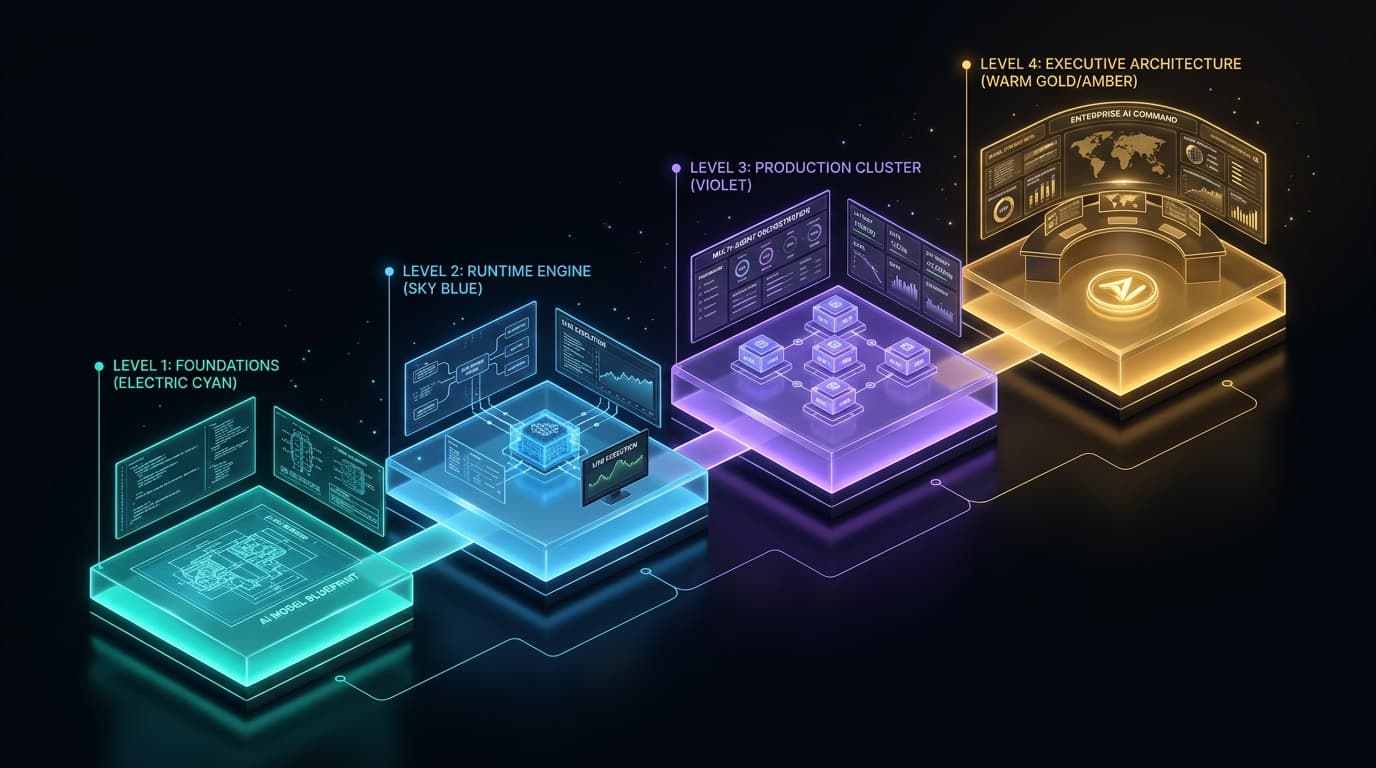
What You Will Engineer
Implement production LLM patterns with structured JSON outputs and retry strategies
Build custom knowledge retrieval layers with document ingestion and reranking
Connect live external tools: CRMs, calendar, transactional email, and databases
Architect multi-step agentic workflows with conditional loops and approval gates
Implement persistent memory stores with session checkpoints and state hydration
Build human escalation queues and automated test suites for hallucination defense
Syllabus Architecture
Module 1: Production LLM Patterns
Prompt architecture, structured JSON schemas, token economics, streaming, retry strategies, and fallback models.
Module 2: Knowledge Systems
Document ingestion, parsing, chunking, embeddings, vector databases, reranking, and citation/source tracking.
Module 3: Tool Integration
Function calling, database tools, CRM, email, calendar, webhooks, external services, and secure authentication.
Module 4: Agentic Workflows
Deterministic vs agentic workflows, routing, planning, tool selection, sequential and parallel execution, loops.
Module 5: Memory & State
Short-term context, long-term memory, workflow state, persistent checkpoints, and memory quality filters.
Module 6: Human Escalation
Confidence thresholds, approval queues, human takeover, escalation routing, notifications, and audit trails.
Module 7: Build the Employee
End-to-end integration: customer support or operational employee combining knowledge, history, tools, and policies.
Module 8: Testing the Employee
Unit testing, workflow testing, prompt testing, hallucination testing, bad inputs, and tool failure recovery.
Practical Project Defense & Rubric Review
Working AI Employee: Build and demonstrate an actual functioning AI employee performing live business work with APIs, state persistence, regression testing, and escalation queues.
Begin your journey in AI Workforce Builder.
Master the architectural patterns that transform language models into reliable, production AI workers.